The fado folds in on itself all the time, and I'd say that's one of the reasons it manages to stay around and to maintain its health.
Herman José, a TV personality on RTP (the big Portuguese network), has been around and involved in the fado in one way or another for a long time. He plays the clown, but I think he is dead serious. I want to talk briefly about this clip from a very recent show.
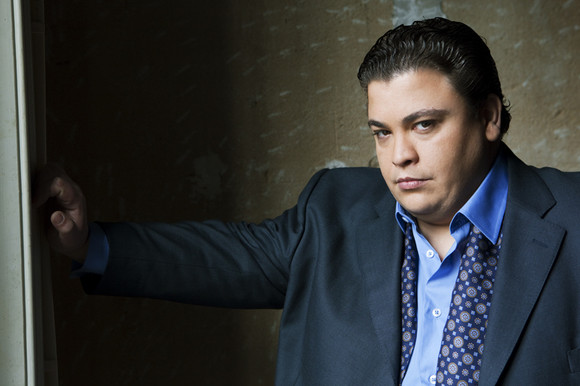
Herman is interviewing Ricardo Ribeiro, who has a second CD out now (very good by the way), called Porta do Coração (Gateway to the heart). Herman gives Ricardo Ribeiro a little quiz ("With whom is the following fado associated?"), then there's a brief discussion about the record, then it's off to the races with Ricardo singing "Agua Louca da Ribeira".
My understanding is that Ricardo, along with Pedro Galveias and a bunch of other singers, learned part of what he knows ("in life and about the fado", according to Ricardo) via Fernando Maurício--a singer known exceedingly well in Portugal, but not outside. Here he is singing on Herman José's show (date unknown, but obviously more than a few years ago). This is by far the best quality video of Fernando Maurício on youtube (the section with Fernando Maurício starts at roughly 3:00 into the video).
Fernando Maurício sang the last 11 or so years of his life at Os Ferreiras, and that's where Pedro and Ricardo worked with him. Here is a desgarrada happening there. Very sadly, the owner of the restaurant, António Ferreira, died recently.
Back to Ricard Ribeiro. At the end of the fado, Herman asks Ricardo Ribeiro to introduce the musicians. On the guitarra Portuguesa is Pedro de Castro, one of the bosses of the Mesa de Frades in Alfama (if you stay really, really late you might here Ricardo Ribeiro there). On the viola is Jaime Santos Jr., the son of a tremendous guitarist and composer, Jaime Santos (played with Amália), who is himself an excellent musician ("perfect marks" in music school, I was once told). On the viola baixa is Professor Joel Pina, who is 90 and still playing actively. He played with Amália, played with everybody--including Raul Nery (who played Portuguese guitar for Maria Teresa de Noronha and obviously tons of others). His presence causes Herman to get out of chair.
On the couch is Rui Nery, who is Raul Nery's son and probably the highest profile musicologist of the fado. Nery goes on to say something beautiful, which is that it was Jaime Santos' father who gave him his first watch. Moreover, Jaime Santos Junior later became one of his (Rui's) students at the music academy in music history. Interview continues here.
I am hoping beyond hope that Rui Nery puts together a biography of his father.
Anyway there you go. These kinds of connections (as Nery called them) are completely common in the fado. Everybody knows everybody. Sometimes that works out beautifully (as here), and sometimes it produces the INVEJA.
Stick around for the end of Herman's show, where Maria da Fe sings. Joel Pina stays on to play the viola baixa.
Thanks to Ricardo Ribeiro for verifying the story about Fernando Maurício and Os Ferreiras. I should note that there's an English translation of an interview with him here.
There is way too much to talk about in the fado...
A blog about things happening now in the fado of Lisbon.
Nota: faça um clique no botão de Google Translate (à direita) para aceder uma versão deste site em português.
29 August 2010
11 August 2010
Some recent interviews on Rádio Amália
Inga Oliveira at 92.0 (Rádio Amália) has been running some very informative interviews lately with fadistas. The program is called "Estrela da tarde" ("Star of the afternoon") and in addition to interviews there are live in-studio performances. Over the last couple of days I have been doing alot of driving, and so had a chance to catch up on a few of the programs via its podcasts.
Dulce Pontes. I was a little bit surprised when I saw her listed as a guest. I am not hugely familiar with her repertory, but always had the impression that she was not a traditional fado singer. But as the interview unfolded it became pretty clear that she has been connected to the fado for a long time. She told the story of meeting Amália at Amália's house (I presume the famous one in Lisbon), and staying until the wee hours of the morning talking and drinking tea. The story of her early relationship with Amália revolved around her performance of the song "Lagrima" ("Tear"--the kind you cry), which Pontes recorded early in her career (listen below) and which Amália had recorded much earlier. (This part of the conversation starts around 2:55 into the interview, when she says "The person who gave me the desire to sing fado was Amália"). Evidently (4:18) Pontes did not contact Amália about recording "Lagrima", but Amália noticed the performance and (it seems) invited her for a visit. Pontes did not go into alot of detail about the conversation that went on that night, which is too bad!
Pontes goes on to talk about the innovations that Amália brought into the fado (others might call some of these innovations degradations), which included new poems, composers (and I would say also instrumentation and orchestration). Indeed, if you listen to some of the later work from Pontes, you'll hear plenty of music that sounds related to fado, but that is also related to other musics. The point made in one of the other podcasts, by José Gonçalez (who was there with António Pinto Basto). But more on this in the next post.
Dulce Pontes. I was a little bit surprised when I saw her listed as a guest. I am not hugely familiar with her repertory, but always had the impression that she was not a traditional fado singer. But as the interview unfolded it became pretty clear that she has been connected to the fado for a long time. She told the story of meeting Amália at Amália's house (I presume the famous one in Lisbon), and staying until the wee hours of the morning talking and drinking tea. The story of her early relationship with Amália revolved around her performance of the song "Lagrima" ("Tear"--the kind you cry), which Pontes recorded early in her career (listen below) and which Amália had recorded much earlier. (This part of the conversation starts around 2:55 into the interview, when she says "The person who gave me the desire to sing fado was Amália"). Evidently (4:18) Pontes did not contact Amália about recording "Lagrima", but Amália noticed the performance and (it seems) invited her for a visit. Pontes did not go into alot of detail about the conversation that went on that night, which is too bad!
Pontes goes on to talk about the innovations that Amália brought into the fado (others might call some of these innovations degradations), which included new poems, composers (and I would say also instrumentation and orchestration). Indeed, if you listen to some of the later work from Pontes, you'll hear plenty of music that sounds related to fado, but that is also related to other musics. The point made in one of the other podcasts, by José Gonçalez (who was there with António Pinto Basto). But more on this in the next post.
04 August 2010
Vítor Rodrigues
As someone I know once said, it is impossible to talk about the fado without talking about inveja, which can be understood as jealously or envy. Today I ran into a video on purofado's channel that reminded me of a particularly unpleasant bout of the inveja that involved a singer I learned of only recently, Vítor Rodrigues.
We (some friends and I) decided to visit the Baiuca, one of our favorite places to hear fado in the Alfama. Indeed, one of the places that for us was synonymous with the fado. I was introduced to Vítor and we started talking about his work as a singer and writer, and came to the discussion of a particular poem that he had written, "Miúdo da fonte santa." When it was close to his time to sing, he said that he would be singing that one. He did, and it was great. He came over to me after singing this song and asked if I liked it. I said "Yes, very much." And he pulled out his CD and said, "Here, take it. It's a gift." Then arrived the inveja: the singer who was going to be on next said, "Vítor, are you going to sing or are you going to be trying to sell CDs?" Vítor got pretty upset at this. (For a while, the sale of CDs has not been permitted at the Baiuca--something which he knew.) What happened next was very much a full-scale argument that suddenly involved a bunch of people. Some of the singers waiting to sing left the premises. There was even some pushing. It was very unpleasant and to this day I feel some responsibility for what happened. In fact I even wrote to the owner trying to explain things from my perspective. It was a very sad way to spend our last visit there (at least for a while), and more importantly I felt to blame for getting involved perturbing the day-to-day (working) life of the fado--something I tried (with success) for an entire year not to do.
So here is Vítor Rodrigues singing Trigueirinha, a song written by Jorge Fernando and sung by many, many singers--including Artur Batalha and Jorge Costa (somebody you can read about on my other site). The lyrics in Portuguese are here.
We (some friends and I) decided to visit the Baiuca, one of our favorite places to hear fado in the Alfama. Indeed, one of the places that for us was synonymous with the fado. I was introduced to Vítor and we started talking about his work as a singer and writer, and came to the discussion of a particular poem that he had written, "Miúdo da fonte santa." When it was close to his time to sing, he said that he would be singing that one. He did, and it was great. He came over to me after singing this song and asked if I liked it. I said "Yes, very much." And he pulled out his CD and said, "Here, take it. It's a gift." Then arrived the inveja: the singer who was going to be on next said, "Vítor, are you going to sing or are you going to be trying to sell CDs?" Vítor got pretty upset at this. (For a while, the sale of CDs has not been permitted at the Baiuca--something which he knew.) What happened next was very much a full-scale argument that suddenly involved a bunch of people. Some of the singers waiting to sing left the premises. There was even some pushing. It was very unpleasant and to this day I feel some responsibility for what happened. In fact I even wrote to the owner trying to explain things from my perspective. It was a very sad way to spend our last visit there (at least for a while), and more importantly I felt to blame for getting involved perturbing the day-to-day (working) life of the fado--something I tried (with success) for an entire year not to do.
So here is Vítor Rodrigues singing Trigueirinha, a song written by Jorge Fernando and sung by many, many singers--including Artur Batalha and Jorge Costa (somebody you can read about on my other site). The lyrics in Portuguese are here.
30 July 2010
Maria Teresa de Noronha
If you can read Portuguese--or if you believe Google translator--then I can wholeheartedly suggest reading the latest entry in Vítor Marceneiro's blog, this one about Maria Teresa de Noronha, written by one of the great, great guitarists--Raul Nery--who played for her for many years. Near the end he says "Ela e a Amália são as maiores fadistas. E não posso dizer que uma seja melhor que a outra." That is, "She and Amália were the greatest female fado singer. And I cannot say that one was greater than the other."
There is so, so little written about her, that to hear something coming from Raul Nery really is a wonderful surprise. link to the post
27 July 2010
João Soeiro
A fadista I really like as a singer and a person. He gets up there and, I think, tries to find everyone in the room. He has been very modest in his ambitions, steady I would say. In fact, he started singing rather late, via the encouragement of friends (I don't have his survey results in front of me, but will post them later--they're interesting).

It was great to hear him on Radio Amalia the other day. Some very charitable person captured his performance in a few videos.
I also wrote a bit about him on my other site, where you can also see more videos.

It was great to hear him on Radio Amalia the other day. Some very charitable person captured his performance in a few videos.
I also wrote a bit about him on my other site, where you can also see more videos.
Way to go João!
26 July 2010
I finally got around to translating an article by José Lúcio Ribeiro de Almeida entitled 'Learn to listen to fado, with open ears. The fado isn't "heard"--it "happens.' Translation is here.
25 July 2010
Just finished watching the 2006 'Grande Noite de Fado' (Gala Night of the Fado) on RTP/International. The program on RTP was 90 minutes long. I suspect the original show was considerably longer. The people on the broadcast are listed below. Note that there is a contest for the Grande Noite de Fado to find the best amateur singers and musicians (not lyricists, though, so far as I can tell). People are either in the 'senior' or 'junior' category depending on their age. The contestants are numbers 2 through 5 on the following list. The others were there to be recognized for one thing or another.
- Celeste Rodrigues (Amália Rodrigues' sister, but also a very good singer in her own right.) Here she is from a few year ago singing "Lavava no rio, lavava" The poem was written by Amália. My literal translation of the title is pretty poor ("I used to wash in the river"). It's a wealthier woman singing to her mother about her life as a poor child. The last stanza says, "We are no longer have the hunger we had, mother, but neither do we have/the desire not to have it. We no longer know how to dream, we are no longer able to remember / the desire to die."
- Joana Catarina Valente Teixeira (J-F) (she won, and Sara Correia, who they did not show, got second place. I have a record of Sara's and it is pretty good.)
- José Luís Godinho Geádas (J-M)
- Maria Emélia Reis (J-F)
- Joana Felipa Caetano Luz (J-F)
- Carminho (got the prize for 'revelation of the fado' but couldn't sing because she had just had some kind of surgical procedure. Now, five years later, she is famous and a very good singer indeed.)
- Teresa Siqueira (because Carminho couldn't sing, her mother did!)
- Artur Batalha (one of my favorites. He took the prize for best male singer in 1971, but that year is not listed on the Wiki page)
- Cuca Roseta (appeared with her boss from the Clube do Fado in Lisbon, Mário Pacheco--a guitarist whose club won the prize in 2006 for best fado house)
- Then singing a medley of Carlos do Carmo tunes were Teresa Tapadas, José da Câmara, António Pinto Basto, Maria Armanda. José da Câmara is the son of Vicente da Câmara, a singer of the 'aristocratic' fado. If I am not wrong, JdC's son is now a singer, and in fact sang with his father and grandfather in 2009 or so.
- Finally was Rodrigo, who came down from Cascais to get an award for a career of distinction, and also to sing 'Recado de João Dias' (obscure but immensely good) and 'É tão bom ser pequenino', about which he said 'Isto é Portugal a caminhar', a phrase that means 'this is Portugal walking', and one that he attributed to the guitarist Armandinho. The song means 'It's good to be young.' The construction of the lyric is interesting. Each line of the opening stanza is the final line of a subsequent stanza, in order. On his site, José has conveniently highlighted this construction through color. The lyricist was João Linhares Barbosa, and the music is the fado 'corrido'--the running fado. I should really rush to add that there are other versions of 'É tão bom ser pequenino' that take the same approach. For example, here's one by another great poet, Carlos Conde.
- The other fado, 'Memory of João Dias' is really hard core. The poet is looking back over his life and telling everyone first that it was all a mess, that he didn't care, and that absolutely no one at his funeral should say 'He was a good man' (in particular because he himself did not think so). I spent many, many hours this last trip to Lisbon looking for any books with Dias' poems in them--no dice. But the guy was really, really good. I recorded the show, so maybe I will take a shot at transcribing the lyric (it's not on José's site, or anywhere else that I can find. I don't even have a copy of the song aside from the video). Then I'll send it to José.
a new page
With a little bit of prompting, I am trying out an idea, which is to write about everyday doings of the fado. I don't have a clear plan. The site might have record reviews, interviews with people inside the fado, ruminations on TV shows, who knows.
There are three reasons why this idea is absurd. First, no one is listening. Second, I am very far away from Lisbon. Third, I am writing in English. (I have a bunch of stuff already written and on the web in Portuguese. It's here: http://noitesperdidas.net.) I could write this thing in Portuguese, but I'm not sure that would make sense. The daily life of the fado and the Internet do not have a ton in common (though some stuff does appear to be happening on Facebook these days). So I doubt that anyone in Portugal would care.
Let me see what I can do with this.
DM
31 January 2010
Lately I am listening to alot of older fado, especially Ercília de Costa (http://lisboanoguiness.blogs.sapo.pt/69916.html), and fado that is somewhat later, like Alfredo Marceneiro. I think my listening was spurred on by something I read (probably in Vitor Marceneiro's fantastic blog) that saudade now is not what is was "then". When I listen to 'Lisboa Antiga' or any of the other poems that talk about Lisbon in the 1950s or earlier, I think this sentiment makes sense. The amount of cynicism and opportunism surrounding the fado in the popular press (actually starting way back) as well as in day-to-day life is really something. If I can be a bit cynical myself for a moment, I suppose it's easy to say anything you want about fado and its history when there is very little scholarship relative to the significance of the music in everyday life. Perhaps there is a decent biography of Amália to be found somewhere (I am pretty sure there is not one of Fernando Maurício, and I haven't gotten a copy of Marceneiro's)--but really, is that all there is?! At a later date I'll post some pointers to recent publications on the fado. Perhaps we are on the verge of a serious bit of attention paid to "fado fado".
29 September 2008
Subscribe to:
Posts (Atom)