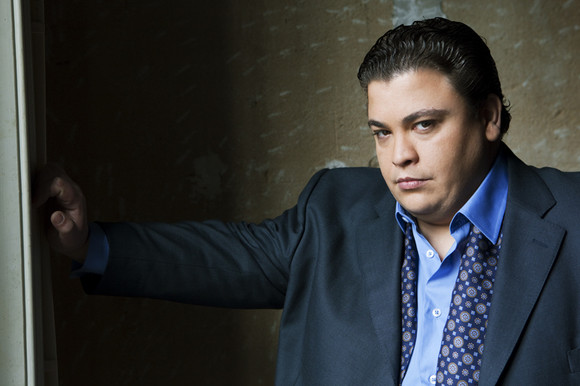
As mentioned in a previous entry on this blog, Artur Batalha appears on a track of Mariza's new album, Fado Tradicional. Batalha is probably my favorite living male fado singer--and his appearance on the album is a big professional break--so I thought this would be a good time to write about him. The information below is taken mainly from two interviews conducted by me or by my friend António Lisboa with Batalha himself during the last 18 months.


Life and Work
Artur Henrique dos Santos Batalha is a fadista born in the Alfama (Lisbon) on 14 April 1951. His first time singing in public was at age nine, and he began his career at the age of 14 in the Taverna do Embuçado, which at the time was owned by João Ferreira-Rosa. In 1971 Artur Batalha won the Noite do Fado at the Coliseu dos Recreios in Lisbon, and went on to sing in various countries and on television.
 |
| from http://fbfadoporto.blogspot.com/ 2008/11/artur-batalha.html |
Below at left is Batalha's version from sometime during the 80s. The track was re-released recently on the record Príncipe do Fado from Metro-Som. Below at right is the version with Mariza from the new record.
Metro-Som has done a good job of re-releasing selected tracks from Batalha's catalog, even if the documentation is downright anemic (and the production occasionally sketchy). Here is a list of the tracks from the reissues of his early work on that label. The records I have are Príncipe do Fado (volumes 1 through 3), Jóia do Fado, and Filho do Fado. I have no idea how big his original catalogue is. However, there are a few scans of releases in vinyl here (scroll down to "capas" then find his name).
One thing that impressed me with Batalha was his singing of the fado Menor, something that was not done very often in the fado houses I frequented. (In fact Felipe Lucas, one of Dulce Pontes' guitarists, once told me that, after a week at the Baiuca, not one person had asked him to play the fado menor.) In addition to the Menor, Batalha stated that the fado Proença and the fado Vitória are essential in his repertory. His choices for fadistas and/or musicians of reference to him provide some further insight into his work. These are Tristão da Silva, Amália Rodrigues and Fernando Farinha.
It is well known that Batalha went through a number of years of very serious personal difficulty, including addictions to various substances. These are over and he is in great form. At the time of my interview with him (16 April 2010), he reported having sung in public more than ten times over the previous months, in the bairros of Serafina and Bairro Alto, and in the freguesia of Pena.
 |
| Batalha and Zé António (date unknown) from http://sylvielasserre.blogs.com |
Personal Impressions
I first heard Batalha singing live at the restaurant “Os Ferreiras”, on Rua São Lázaro em Lisbon, and I continued to visit there to hear him and the other excellent fadistas that sang under the late António Ferreira's stewardship (Batalha is third row down from the top, in the middle). (A complete list of my videos from these visits is here--just do a query on "Artur".) I can't make out exactly who is in all of the photos, but from top to bottom, left to right. they are probably (unknown), Júlia Lopes, José Cardoso; Joana Veiga, Jaime Santos, Kátia Santos; António Pinho, Batalha, Eduardo Leite; Ricardo Aires, António Ferreira, (unknown).
 |
| Montage of Artists Outside Os Ferreiras |
I was impressed by the quality of his voice, and also with his physical presence--particularly his ability to command attention in the room.
It is worth watching the video of Batalha singing a few years ago at A Barraca, with Carlos Gonçalves on the Portuguese guitar, and Lelo Nogueira on the viola. After an introduction by the manager, Batalha thanks everyone and dedicates the fado, "Noites Perdidas" to a friend who is there. The video is rare for showing how the fado happens in an intimate setting among friends, and is really one of the most emblematic I've found (sorry I cannot embed it).
One night I visited the Os Ferreiras with a friend from out of town, and as the hours waned we watched the crowd gradually diminish--until, at sometime around 2am, there were only about ten people left. Batalha asked what we would like to hear. Another client and I tried to convince him to sing "Meu Irmão Fora da Lei", but to no avail: it was "Sonho Tropical", a lovely fado but on a very different theme. Here are the two fados.
Meu Irmão Fora da Lei
Sonho Tropical
But on the other hand, I never heard Batalha participate in any of the desgrarradas that happened frequently at Os Ferreiras. Perhaps that is not a particular strength of his. The desgarrada requires a ready repertory of phrases that can be employed to challenge prior singers. I've never heard Batalha sing the kind of humorous stanzas that are the stock in trade of the desgarrada, so perhaps this is one factor. Fortunately, some friends were at Os Ferreiras one night when Batalha did in fact participate in a desgarrada at Os Ferreiras (with Jorge Fernando no less). Here is the evidence.
One thing I have to mention. The first night of fado after the death of Michael Jackson (yes, that one), I was at Os Ferreiras and talking with Batalha during one of the breaks. Batalha wanted to talk about Michael Jackson. "Morreu o nosso colega", he said ("Our colleague has died."). I was pretty floored, but I guess great music is great music.