22 November 2010

Fado in Newark, NJ--Report

Great night of fado. Everybody showed up, and there were a few surprises along the way.

The evening opened with a guitarrada (duo of guitars) played by Michael da Silva (v) and Pedro da Silva (gp). Michael da Silva surprised everyone (including the MC) by being the first to sing, then it was over to Nathalie Pires to sing three fados. Nathalie has been doing some really good work, singing all over the place (in NJ, other places in the US, plus Portugal). We then had a brief break for the changeover to the guests from Portugal.

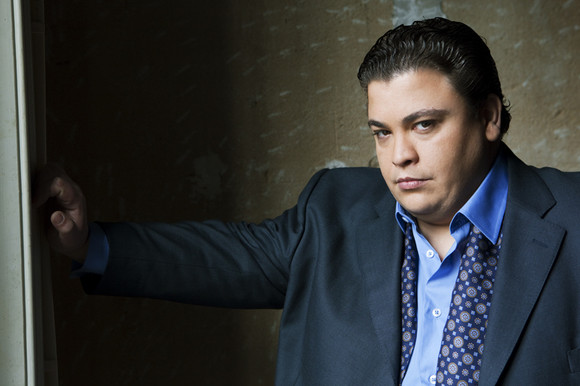
Jorge Fernando
Jorge Fernando (viola) and José Manuel Neto (guitarra portuguesa) opened with a guitarrada. After the closing by Neto, one of the guys at our table (a Portuguese) leaned over to me and said "You know, he really is quite good." Jorge Fernando had something similar to say later: "José Manuel Neto is, to me, the best living player of the guitarra portuguesa." JM Neto turned his head to indicate he was not comfortable with the comment, prompting J Fernando to say, "He doesn't like it when I say 'the best'. He would prefer I say 'the only'" All in good fun, I can assure you!

While I am on the subject of our neighbors at the table, my wife and I quickly discovered that the group was rather eclectic: a man from Lisbon and his wife from Montijo; one American guy who knows alot about the fado and owns more fado records than I'll ever have; his friend who was there via Israel, Germany and France; another friend of his; plus an opera singer and her husband. We spent alot of the night talking about Lisbon, the bullfights in Montijo, and anything else that came to mind. "The French cheese reminds me of the Portuguese cheese." To which our newfound friend replied "They [the French] would love that." His companion grew up with Dulce Pontes, so that was more food for conversation.


Fábia Rebordão
The next singer of the evening was Fábia Rebordão (left). Her choice of lyrics was pretty adventuresome. I did not recognize the lyrics, but they were not the usual fare. Must remember to check out her recorded output. She has a deep, earthy voice. Her version of "Chuva" was lovely. It is very easy to imitate Mariza in singing this song (written by Jorge Fernando), and I am happy to say she did not. Her singing instantly brought us back to the many, many hours we spent with the fado in Lisbon. For me she was the big discovery of the evening. I do not have a video of her, but here is a link to her in action singing "Meu amor, meu amor" at Casa de Linhares in Alfama, and here singing "Chuva".

After Fábia, it was Jorge Fernando, then Filipa Cardoso. Her singing caused our Portuguese friend to get out of his chair (first time for the night). It was then Fábia, then Jorge.

I think it was during Jorge Fernando's second turn that he said "is there anything in particular that you all would like to hear?" It took me 50 miliseconds to respond "Boa Noite Solidão". To which he replied, very sternly, "Boa Noite Solidão", then played it. I'm not sure what it was, but his version seemed much stronger and more forceful than what I might have expected. Here is Fernando Maurício singing it; and here you can hear Jorge Fernando singing it (and also hear some of the other tracks from a recent album of his).


(L-R) José Manuel Neto, Jorge Fernando, Fábia Rebordão,
Filipa Cardoso, Michael da Silva
Time for a surprise. Jorge Fernando made a very lovely speech about how events like this one serve to bring Portugal to the Portuguese living in the US, but also the other way around: with a visit like this, the musicians learn about how their fellow Portuguese are living abroad, and this helps strengthen the ties between them. He then invited Pedro Botas, a Portuguese American fado singer living near Newark, to sing. For some reason, Pedro took out his cell phone and was looking at it while just below the stage, at which Jorge said, "Pedro, there is no need to call--I'm here." Here is a brief sample of Pedro in action from another night. 

Then it was back to Nathalie Pires, who was followed by Hermínio Silva, who was a winner of the "Grande Noite de Fado" in 1973. That was really a blast. The night ended with Fábia, Jorge and Filipa.

20 November 2010

Fado in Newark, NJ

Tonight (20 Nov 2010) there is a great looking fado show happening at the Mediterranean Manor in Newark, NJ. The event has been put together by Michael da Silva, a fado empressario who also has an annual gig in Lisbon playing at Casa de Linhares/Bacalhau de Molho. His site is here.

The two obvious heavy hitters here are Jorge Fernando, who composed "Boa Noite Solidão" along with alot of other music, and who has played with approximately everybody; and José Manuel Neto, a tremendous guitarist who also has played with approximately everybody.  I do not know Filipa Cardoso or Fábia Rebordão, but understand that they are up and coming fadistas. Nathalie Pires is a luso-american fado singer who I have heard sing twice and who is good. I've only heard Michael da Silva once (when Pedro Galveias and Rodrigo were here in Newark not so long ago), and never heard Pedro Henriques da Silva. Given Michael's excellent taste, I expect this will be a great evening. Let us pray that the /intervalos/ are not /maratonas/!

Here is the lineup for the evening:


Fadistas
Filipa Cardoso
Fábia Rebordão

Nathalie Pires


Musicians
Jorge Fernando (viola; voz)
José Manuel Neto (guitarra portuguesa)
Michael da Silva (guitarra portuguesa)
Pedro Henriques da Silva 
(guitarra portuguesa)


Location
Casa Seabra Mediterranean Manor
255 Jefferson St.
Newark, New Jersey


Time
7pm (I will be shocked if the music starts any time before 9pm though!)

11 November 2010

Mariza??!

Yes, Mariza. Looks like the new record is going to be traditional fado, and will include one fado with the great Artur Batalha. Thanks to the excellent blog, fadocravo (http://fadocravo.blogspot.com/), for pointing this out!

http://www.hardmusica.pt/noticia_detalhe.php?cd_noticia=6896

Here is Batalha:
http://www.youtube.com/watch?v=rzI-KJj7o4U
http://www.youtube.com/watch?v=LdIau16PpTE

little update. Here is Mariza (without Batalha, but with Ângelo Freire on guitarra portuguesa) singing this "Promete, jura" (aka, "Estas a pensar em mim"):
http://www.youtube.com/watch?v=Plwa373Mc0Q

25 September 2010

Listening to Fado

While I'm working on transcribing, verifying and translating an interview with Tony Loretti, here is a short piece on listening to the fado. The text is my translation of most of a short essay by José Lúcio Ribeiro de Almeida. You can see the original Portuguese version here:
With Sr. Ribeiro de Almeida’s permission, I’ve left off a bit of his original discussion, which mostly addresses the recent historical context for the fado in terms of Salazar’s “Three Fs”--Football, Fado and Fátima. There is a small chance that that portion of the text will be augmented (by him) then translated for inclusion here.


Learn to listen to fado, with open ears. The fado isn't "heard"--it "happens".
By José Lúcio Ribeiro de Almeida 
(trans. DM)

When one likes to listen to Fado, it's best--as the people say--not to eat cat as if it were rabbit. Now we see the "hamburgers of Fado" appear more and more. They don't know how to sing, they are 'semi-toned', they don't have the voice, they don't know how to divide the poem, they don't know how to breathe over the musical frases without losing their breath in trying hold the melody, they sing fado without caring whether or not their musical prowess will permit them to sing it, and--finally--they sell alot of CDs, receive alot of applause and good words from the specialists in the material, and people who like Fado listen to them thankfully, which is a serious thing indeed. No one eats spoilt food. So why is the fado sung poorly and no one says anything?

But I am going to give you a simple recipe to improve your knowledge of the Fado. If you like the Fado, then read this with attention. 

1. Do not confuse listening to Fado with listening to a CD of Fado. Listening to Fado means being there, live and without a net, where the true thing happens. The CD is the cynical side of the Fado. Or perhaps you think that when someone attempts to record a CD and things don't go well (that is, if someone makes a mistake), then the recording is left as is. But of course it is not. The person goes back and records again and again, until the recording is OK. With the advanced technology of the computer, there are already programs that enable mediocre singers to sound perfectly fine. But only on CD, because live they are a disgrace.

2. If you like a particular Fado, try to learn the composer of the music (careful with the Fado Acácio, because Acácio is not the author but the name of the music) and the author of the lyric. Learn who are the musicians playing. In the fado, the viola player and the guitarist together are called the 'parelha' [pair]. If it's a Popular March, the group of 7 musicians is called the 'Cavalinho' [little horse]. For the fado to 'happen' (that is, to hear good Fado) the 'Yantra of Fado' (the esoteric triangle of the Fado) has to happen: the person who sings has to sing well, the musicians who play have to play well, and the audience has to listen well. When somebody says, "Quiet--the Fado is going to be sung", that is a bad sign. Which is to say that the audience is probably noisy or perhaps more interested in conversing than in listening to the Fado. The word 'Fado' is more associated with the singer, but the Fado does not continue to thrive just because of the singer. To the contrary, the singer is the final element of the Fado. First somebody has to construct the guitar and the viola, then compose the music and the lyrics, then learn to play in the key of the person who is going to sing, and only then does the 'artist' appear, who is always the person who gets paid.

3. The Fado requires physical proximity. If there are microphones, that is a bad sign. They are now selling big shows of Fado that are not Fado. The thing is that a big Fado show brings more people, and the fado itself may be sung on a football pitch, in a bull ring, or in another large area, and this is all synonymous of the business of Fado and so is not Fado at all. Which is to say quantity and not quality. As is logical, the big Fado shows on television require microphones, but these are big shows--not Fado. There is a big difference between hearing the Fado in a small Fado house versus in a big show or on television. To get to know the feeling of this difference, go to a restaurante with a healthy appetite. Watch the others eat but you yourself don't eat.

4. If you like Fado, make a rule in your life to go at least once a month to hear Fado. Choose the location well. There are plenty of places where cat is served as rabbit. So what is there to do? Whoever doesn't know ought to go looking in order to be informed.

5. If you go to hear Fado, don't take anybody with you who doesn't like Fado, or anybody who you haven't seen in a long time. If you do, it's natural and likely that the talk about olden times will take precedence over the fado.

6. If you can--and if the artists approve--record and photograph a session of the Fado. You will see that, upon hearing it at home, the recording will have the taste of the truth.

7. With the appearance of the CD, the great archives of the Fado will continue to reside only on 78rpm or 33rpm vinyl records. If you can, get ahold of a record player and look for records from your preferred artists.

8. In your collection of Fado--whether records or CDs--always have some good 'guitarradas' [fado music but no voice]. Listen with attention to the 'guitarrada', since the music without the voice gives other a different type of knowledge of the Fado. 

9. Finally, if you like the Fado and none of this appeals to you, continue to enjoy the Fado in your own way. My intention in writing this text was simply to share with you what I've learned over roughly 40 years. I say 'learned', but I mean 'know'. For this reason I consider myself an investigator of the Fado, a person who studies and learns every day. Not a 'musicologist', because while in the old days this expression was used for investigators and for the studious, now it's used only for PhDs.

If you don't agree with me or you find errors in what I've written, tell me why. I knew somebody who would often say, only everybody knows everything.

José Lúcio Ribeiro de Almeida

17 September 2010

Maria Teresa de Noronha

It looks like there are more than a few hits coming to this site because of Maria Teresa de Noronha. She happens to be one of my favorite fado singers. Here are a few points about her and her work.

Biographical details on her are scant on the web. The best writeups I've found are (not surprisingly) published by Vítor Marceneiro. One of my favorites is a piece by her long-time guitarist, Raul Nery, who is still alive:

http://lisboanoguiness.blogs.sapo.pt/218080.html

A straight ahead bio is here:

http://lisboanoguiness.blogs.sapo.pt/194064.html

where we learn that her full name was "Maria Teresa do Carmo de Noronha Guimarães Serôdio (Paraty)",  and that she was called Baté by her friends. She lived from 1918 to 1993. If you go to the Panteão Nacional in Lisbon, you'll find plenty of her relatives buried there. Dom Vicente de Câmara is a cousin of some sort.

There is a Wiki entry that is not ridiculous:
http://en.wikipedia.org/wiki/Maria_Teresa_de_Noronha

The part that blows my mind is this: "In 1938, at the age of 20, Maria Teresa de Noronha was invited by the Portuguese broadcasting company (Emissora Nacional) to perform at a regular biweekly fado program, which she did uninterruptly until 1961, with the exception of a 4-year pause following her marriage in December 1947 to the Count of Sabrosa" Let's say she sang three fados every other week for 20 years. So, RTP, where are those approximately 1500 recordings anyway???


Her records appear to be slowly being re-released. Fado Antigo and Saudades das Saudades are two, and they are both excellent. See here: http://www.playme.com/mariateresadenoronha/album/

There is a very good and representative collection of her music (in the Biografias do Fado series). It has 20 tracks, first is "Fado da Idanha", last is "Gosto de ti quando mentes". You can get it online pretty easily. Try also looking under the title "O Melhor de Maria Teresa de Noronha" (contents are exactly the same, down to the liner notes).

EMI released a four CD box set some years ago that is completely sold out. If you find it, get it.

If you're in Lisbon, visit the record store Discoteca Amália and ask for the CD Inéditos para a história do fado ("Unreleased tracks contributing to the history of fado"), which pulls together some unreleased work that does not appear on the EMI collection. I think there are not tons of copies of it left.


Finally, a few videos of her are starting to appear on YouTube. Here are three (all with Raul Nery and Joaquim de Vale). Many thanks to user Fado3Carabelas for posting these.

Fado Rio Maior: http://www.youtube.com/watch?v=ukRlfw6ZbHU
Fado da Sina: http://www.youtube.com/watch?v=KtD52dXZJAs
Fado da Idanha: http://www.youtube.com/watch?v=NhKi4xbNpXg

29 August 2010

The fado folds in on itself all the time, and I'd say that's one of the reasons it manages to stay around and to maintain its health.

Herman José, a TV personality on RTP (the big Portuguese network), has been around and involved in the fado in one way or another for a long time. He plays the clown, but I think he is dead serious. I want to talk briefly about this clip from a very recent show.

Herman is interviewing Ricardo Ribeiro, who has a second CD out now (very good by the way), called Porta do Coração (Gateway to the heart). Herman gives Ricardo Ribeiro a little quiz ("With whom is the following fado associated?"), then there's a brief discussion about the record, then it's off to the races with Ricardo singing "Agua Louca da Ribeira".

My understanding is that Ricardo, along with Pedro Galveias and a bunch of other singers, learned part of what he knows ("in life and about the fado", according to Ricardo) via Fernando Maurício--a singer known exceedingly well in Portugal, but not outside. Here he is singing on Herman José's show (date unknown, but obviously more than a few years ago). This is by far the best quality video of Fernando Maurício on youtube (the section with Fernando Maurício starts at roughly 3:00 into the video).

Fernando Maurício sang the last 11 or so years of his life at Os Ferreiras, and that's where Pedro and Ricardo worked with him. Here is a desgarrada happening there. Very sadly, the owner of the restaurant, António Ferreira, died recently.

Back to Ricard Ribeiro. At the end of the fado, Herman asks Ricardo Ribeiro to introduce the musicians. On the guitarra Portuguesa is Pedro de Castro, one of the bosses of the Mesa de Frades in Alfama (if you stay really, really late you might here Ricardo Ribeiro there). On the viola is Jaime Santos Jr., the son of a tremendous guitarist and composer, Jaime Santos (played with Amália), who is himself an excellent musician ("perfect marks" in music school, I was once told). On the viola baixa is Professor Joel Pina, who is 90 and still playing actively. He played with Amália, played with everybody--including Raul Nery (who played Portuguese guitar for Maria Teresa de Noronha and obviously tons of others). His presence causes Herman to get out of chair.

On the couch is Rui Nery, who is Raul Nery's son and probably the highest profile musicologist of the fado. Nery goes on to say something beautiful, which is that it was Jaime Santos' father who gave him his first watch. Moreover, Jaime Santos Junior later became one of his (Rui's) students at the music academy in music history. Interview continues here.

I am hoping beyond hope that Rui Nery puts together a biography of his father.

Anyway there you go. These kinds of connections (as Nery called them) are completely common in the fado. Everybody knows everybody. Sometimes that works out beautifully (as here), and sometimes it produces the INVEJA.

Stick around for the end of Herman's show, where Maria da Fe sings. Joel Pina stays on to play the viola baixa.

Thanks to Ricardo Ribeiro for verifying the story about Fernando Maurício and Os Ferreiras. I should note that there's an English translation of an interview with him here.

There is way too much to talk about in the fado...

11 August 2010

Some recent interviews on Rádio Amália

Inga Oliveira at 92.0 (Rádio Amália) has been running some very informative interviews lately with fadistas. The program is called "Estrela da tarde" ("Star of the afternoon") and in addition to interviews there are live in-studio performances. Over the last couple of days I have been doing alot of driving, and so had a chance to catch up on a few of the programs via its podcasts.

Dulce Pontes. I was a little bit surprised when I saw her listed as a guest. I am not hugely familiar with her repertory, but always had the impression that she was not a traditional fado singer. But as the interview unfolded it became pretty clear that she has been connected to the fado for a long time. She told the story of meeting Amália at Amália's house (I presume the famous one in Lisbon), and staying until the wee hours of the morning talking and drinking tea. The story of her early relationship with Amália revolved around her performance of the song "Lagrima" ("Tear"--the kind you cry), which Pontes recorded early in her career (listen below) and which Amália had recorded much earlier. (This part of the conversation starts around 2:55 into the interview, when she says "The person who gave me the desire to sing fado was Amália"). Evidently (4:18) Pontes did not contact Amália about recording "Lagrima", but Amália noticed the performance and (it seems) invited her for a visit. Pontes did not go into alot of detail about the conversation that went on that night, which is too bad!


Pontes goes on to talk about the innovations that Amália brought into the fado (others might call some of these innovations degradations), which included new poems, composers (and I would say also instrumentation and orchestration). Indeed, if you listen to some of the later work from Pontes, you'll hear plenty of music that sounds related to fado, but that is also related to other musics. The point made in one of the other podcasts, by José Gonçalez (who was there with António Pinto Basto). But more on this in the next post.

04 August 2010

Vítor Rodrigues

As someone I know once said, it is impossible to talk about the fado without talking about inveja, which can be understood as jealously or envy. Today I ran into a video on purofado's channel that reminded me of a particularly unpleasant bout of the inveja that involved a singer I learned of only recently, Vítor Rodrigues. 

We (some friends and I) decided to visit the Baiuca, one of our favorite places to hear fado in the Alfama. Indeed, one of the places that for us was synonymous with the fado. I was introduced to Vítor and we started talking about his work as a singer and writer, and came to the discussion of a particular poem that he had written, "Miúdo da fonte santa." When it was close to his time to sing, he said that he would be singing that one. He did, and it was great. He came over to me after singing this song and asked if I liked it. I said "Yes, very much." And he pulled out his CD and said, "Here, take it. It's a gift." Then arrived the inveja: the singer who was going to be on next said, "Vítor, are you going to sing or are you going to be trying to sell CDs?" Vítor got pretty upset at this. (For a while, the sale of CDs has not been permitted at the Baiuca--something which he knew.) What happened next was very much a full-scale argument that suddenly involved a bunch of people. Some of the singers waiting to sing left the premises. There was even some pushing. It was very unpleasant and to this day I feel some responsibility for what happened. In fact I even wrote to the owner trying to explain things from my perspective. It was a very sad way to spend our last visit there (at least for a while), and more importantly I felt to blame for getting involved perturbing the day-to-day (working) life of the fado--something I tried (with success) for an entire year not to do.

So here is Vítor Rodrigues singing Trigueirinha, a song written by Jorge Fernando and sung by many, many singers--including Artur Batalha and Jorge Costa (somebody you can read about on my other site). The lyrics in Portuguese are here.

30 July 2010

Maria Teresa de Noronha

If you can read Portuguese--or if you believe Google translator--then I can wholeheartedly suggest reading the latest entry in Vítor Marceneiro's blog, this one about Maria Teresa de Noronha, written by one of the great, great guitarists--Raul Nery--who played for her for many years. Near the end he says "Ela e a Amália são as maiores fadistas. E não posso dizer que uma seja melhor que a outra." That is, "She and Amália were the greatest female fado singer. And I cannot say that one was greater than the other." 


There is so, so little written about her, that to hear something coming from Raul Nery really is a wonderful surprise. link to the post

27 July 2010

João Soeiro

A fadista I really like as a singer and a person. He gets up there and, I think, tries to find everyone in the room. He has been very modest in his ambitions, steady I would say. In fact, he started singing rather late, via the encouragement of friends (I don't have his survey results in front of me, but will post them later--they're interesting).


It was great to hear him on Radio Amalia the other day. Some very charitable person captured his performance in a few videos.


I also wrote a bit about him on my other site, where you can also see more videos.


Way to go João!