Showing posts with label Filipa Cardoso. Show all posts

25 January 2012

Fado at Carnegie Hall


Jorge Fernando
Jorge Fernando brought a very unique fado show to Carnegie Hall last night (24-Jan-12), one that exploited the tension between the old and the new fado in ways that I'd never have expected.

The typical fado show has a very predictable structure: guitarrada (just the musicians playing), followed by a number of individual singers, each of whom sings three fados and then leaves the stage. There is usually an intermission (the intervalo) somewhere along the line, after which the cycle restarts. The folcloric music and touristic fado of the early evening are gradually replaced by the "fado fado", so that as the night goes on, things usually get more serious and heavy. Jorge's structuring of the show tonight was something else. In sentiment and in intention, it was somewhat like, but both more and less.

Waiting for the fado to happen
The layout of the stage sent a clear signal: six chairs arrayed in a semi-circle—very different from the typical single microphone and a place for the musicians to sit. After the performers entered, instead of a guitarrada, they played something of a ronda, with each singer taking turns singing verses during perhaps half a dozen fados. One fado transformed seamlessly into the next, thus keeping everyone in the audience slightly off balance and attentive.

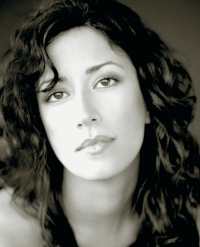
Filipa Cardoso stepped to the edge of the stage to sing "Reviver o passado", followed by Fábia Rebordão for two fados, including a classic about Chico do cachiné—a song for all the Portuguese in the upper balcony. Then Filipa came forward again for "Meu amor marinheiro". So, one singer sandwiched in by another? In the fado? Very strange.

Before the intermission, Jorge Fernando himself sang, this time in duet with Fábia Rebordão—another rarity. But this one worked well because the two harmonized perfectly. (They have been playing together in a trio with one other musicians for some time.) The opening set mainly included songs from straight out of the fado tradition, but expressed within a structure that sat far outside it. My only complaint is that the excellent guitarist, José Manuel Neto, was given very few opportunities to shine (and there were fewer still for the player of the viola baixa, Gustavo Roriz).
In performance

After the intervalo, the musicians opened with a guitarrada that included some beautiful playing by Neto. He has a precise rhythmic touch, purposefully falling a bit behind the beat on his way to a spectacularly fast finish.

During the remainder of the set, there were many times when I felt that Jorge had taken us beyond the fado, whether that meant into new frontiers or over the edge of the precipice.

Filipa Cardoso was followed by Fábia Rebordão, who sang one of Jorge's best known fados, "Chuva"—dosing her delivery with soul and blues inflections. Celeste Rodrigues, the artist of honor for the night, then gave us two pure fados: "Lisboa" and "Meu Corpo" ("My body"), both of which speak of loneliness and separation, from the city in "Lisboa" and from a lover in "Meu Corpo". Reader, I cried. After these fados, and indeed throughout the night, Jorge showed a special tenderness towards Dona Celeste: looking at her warmly, taking her hand after she sang. This made me think of their long history together, bridged by Celeste's sister, the great Amália Rodrigues.

After Celeste's turn, Jorge staked out the opposite frontier of the territory: "Pode ser saudade." Those who knew this song were compelled to sing it, almost by reflex. It's one of those songs, like "Triguerinha"—another of his—that always shows up in the fado, and is always sung by everybody in the audience. But is it fado? Hard to say, but it is now part of the fado. And for me, that makes them fado.

Filipa Cardoso represented the another vein of the traditional fado: her delivery, her presence, her appearance, her repertoire, all sat squarely in it. She is the type of singer you would be lucky to find some evening in Lisbon as you wander from tavern to tavern. Hearing her at 2AM you  suddenly realize you are in the midst of the real thing. As my old musician friend used to say, she has all the coração, sentimento e alma (heart, sentiment and soul) you could want.

The next moment cut me from my moorings: Fábia sang "Bridge Over Troubled Water." It is no stretch to say she is technically an excellent singer, and her rendition of this song probably drew the biggest applause of the evening. While it was definitely not fado, it was a thoughtful nod to her audience, to her sister (to whom she dedicated the song), and perhaps to the realities of the music world these days.

The next stretch of songs was almost all folklore—more evidence of Jorge turning convention on its head. By this point, there was alot of good will in the audience. Celeste sang "Verde Limão", followed by Jorge with "Quem vai ao fado", and Celeste with "Havemos de ir à Viana". All of these are songs about happy times and another vital element of the tradition.

Mais um fado!
They left the stage and it really looked like the show was done: people started leaving, the lights came on, and yet more people left. But the ones who had stayed started clapping, and this was enough to bring the performers back. As they moved towards their seats, Jorge clearly said "No", and directed them to the front of the stage. The musicians propped up their legs on chairs, and the singers stood alongside them. Now we are going to the fado. Celeste wondered aloud if we would be able to hear her. Thanks to the acoustics of the space, we could. What happened next was a thing of beauty, of intimacy, of everything that enables the fado to bring people together, even if the room is Carnegie Hall.


Details on the show:
Singing by Celeste Rodrigues, Fábia Rebordão, Filipa Cardoso, Jorge Fernando.
Portuguese guitar: José Manuel Neto
Viola: Jorge Fernando
Viola Baixa: Gustavo Roriz
Organization: Michael da Silva (left), MD Fado Productions


18 January 2012

Four Upcoming Fado Shows in the US

Carnegie Hall
New York, NY
24 January 2012
See my report.


Incl. New Bedford on 4 February 2012


Clube dos Açores
Newark, NJ
7 April 2012
Also in Mineola, NY on 14 April 2012
Salão da Igreja Nossa Senhora de Fátima
Elizabeth, NJ
18 February 2012
$45–including dinner


Pedo Botas is a young fadista, based in New Jersey, who has been getting a lot of justly-deserved attention. This is his CD release concert, so I expect that he will be in good form.

I have been following Manuela Cavaco for just a few years. She did ask me to rectify a recent comment about her. She said, "Eu não era amiga íntima de Amália, sou sim perdidamente apaixonada por Amália." That is, "I was not an intimate friend of Amália [Rodrigues], but I am hopelessly enthralled by her." She has a very refined and dignified style, and has played with some top-notch people (always an indicator of the quality of the singer). I spoke with Manuela recently about this show, and she is looking forward to performing here. I think this will be a very good show, and at this price it is likely to sell out fast! See and hear a sample of her work here and on her own blog here.

More on this one later...

20 June 2011

The authentic sound of Lisbon arrives in the US: An interview with Michael da Silva

Bringing the fado from Lisbon to the United States--and preserving what makes the fado fado--has never been an easy task. But probably it helps if you know the music--and everything else that goes into the fado-- from the inside out.

Michael da Silva is a musician and empressario who has recently begun organizing fado events in the US, drawing top quality talent, including new sensations like Fábia Rebordão and Filipa Cardoso, as well as more established performers, such as Jorge Fernando and Lenita Gentil.
Michael and his fianceé Ana

Michael's path to the fado began in earnest in 1996 when at nine years old he heard a recording by Amália Rodrigues. The song was "Tudo Isto É Fado" ("All this is fado"), which he says "stood in the door for a lifetime of fado". He credits his parents, both from Portugal, with introducing him to this music. By twelve years old he was playing guitar (but not fado), and at 14 was beginning lessons in playing fado on the classical guitar (viola do fado) with Sr. Alberto Resende, an influential player and builder of the Portuguese guitar active in the Newark, NJ area. Michael continued to study with Sr. Resende for seven years.

At 17 years of age, Michael met a second influential figure: Jorge Fernando, a viola player, composer, lyricist and singer of the fado, who himself started with the fado at a young age. By his late teens, Jorge Fernando's talents had already been tapped by two of the most prominent fado singers of the time, Fernando Maurício and Amália Rodrigues. At 16, he wrote “Boa Noite Solidão”and, at the age of 23, joined the guitarist Carlos Gonçalves to tour the world with Amália.  At roughly the same time in life, Michael da Silva put himself in a similar position: he approached Jorge Fernando directly about coming to Lisbon to learn and play the fado "at his feet". At 20 years old, he played for the first time in Portugal, along with Jorge Fernando and other musicians from Bacalhau de Molho, a fado house in the old Lisbon neighborhood of Alfama. Central to Michael's repertory are the traditional fados, particularly the "Marcha do Marceneiro", the "Corrido" (which he likes to play "smoking fast") and the "Menor."
Jorge Fernando

His passion is for the guitar and for the music, which he communicates both through performance, but also through teaching. His 25 students are a mix of Portuguese and non-Portuguese, but all are exposed through his lessons to fado and to other traditional Portuguese musics. As with many other fado musicians, learning and mastering the main body of fado music--perhaps around 200 different tunes--is an ongoing ambition. He wants, he says, "To be confident enough of my music that, when I feel the saudades for the fado, I can go to Portugal and play. I want to be in a position where, even if someone asks me to play a fado I've never played before, I know enough about fado that I can make the musical changes to play that fado and accompany that fado." He expects to complete a degree in music and to become a music teacher.

When Michael decided to start organizing fado performances in the US, it was in the midst of a month-long stay in Lisbon, playing by Jorger Fernando's side at Casa de Linhares, "living as deeply immersed as I could" in the fado. One night, visiting a café with his fiancée, he was struck by the entirety of the experience: "it was truly magical. I thought, this is missing in America. There is a certain thing that can only happen in Lisbon, a particular kind of X-factor that doesn't exist in the US, no matter how hard we try." Nonetheless, he decided: "I really want to bring this magic over." This means the food and the wine, the music and the lyrics, but much more. As Michael says, "The most beautiful, most pure form of fado is only for a select number of people at any given moment. The light is right, the mood is right, and that's because everyone is feeling it--the musicians, the people, the singers--the whole environment is right."

Fábia Rebordão
In 2010, Michael launched MD Fado Productions. As a kickoff event, he organized an evening of fado—“Fado Nosso” (“Our Fado”)—in Newark, NJ that brought the singers Fábia Rebordão and Filipa Cardoso, and the musicians José Manuel Neto and, of course, Jorge Fernando. Earlier in their relationship, Jorge Fernando had told Michael that he could already foresee Michael organizing shows of this type, and that he would do everything he could to help. The success of the November event, which was held at Casa Seabra on 20 November and attended by more than 250 people, sealed the arrangement. Afterward, Jorge Fernando told him, "Sometimes I feel that I want to gamble with people. I gambled with Mariza, I gambled with Ana Moura, and now I feel that I'm going to gamble with you as a manager."


Filipa Cardoso
The choice of personnel for each performance combines established and new artists, particularly those bringing "new flavors" to the fado. Aside from Filipa Cardoso and Fábia Rebordão, he cites Ana Moura, Carminho and Ricardo Ribeiro as some of the "many incredible young performers of the fado". His experience as a musician, and his participation as a performer at one of the top houses in Lisbon, also provides him with access to some of the top musicians and singers. Michael has also been present for many "perfect" moments of the fado, moments that were completely unplanned and "not written in any kind of agenda or calendar". His experience—as a musician, a devotee of the music and, frankly, as a person of Portuguese descent—helps him set up the scene so that the fado can happen when it wants to.

Michael notes that organizing an event is a cluster of emotions and activities at the same time: printing posters, selling tickets, handling logistics, then actually managing the event--even while taking part in it as a performer. The November event succeeded in bringing the feel of Lisbon to Newark--and vice versa, a point eloquently made that evening by Jorge Fernando when he said that the experience was an opportunity for these two sets of Portuguese people to see and understand each other better.

Lenita Gentil
In November 2011, Michael is organizing a mini-tour of restaurants in New Jersey and, possibly, in Rhode Island and Massachusetts. Expected personnel for this mini-tour are Jorge Fernando, José Manuel Neto, Felipa Cardoso and, for the first time in a long time, Lenita Gentil. They expect to make about three stops on this mini-tour, one in each state, spread over two weekends.

In January of 2012, he will launch "Fado: From Lisbon to New York", at a "very important venue" in New York City. Plans are also afoot to extend this to a month-long tour that would bring many of the artists from the mini-tour, along with some spectacular surprises. Rehearsals and practices for the show are already happening, as are plans for the stage show. Watch for an official announcement in late August or early September on the MD Fado web site.

In the meantime, Michael's business, MD Fado, continues to expand, now including a publicist, an entertainment lawyer, a designer, and a "street team" of individuals working on publicity. With Michael's commitment, background and drive, the future of fado in the US is looking bright.

For information on upcoming MD Fado shows, as well as other activities, see the web site at http://www.mdfado.com.