17 February 2012

Live Fado from Os Ferreiras on Rádio Amália (27-Feb-12)

On 27 February 2012--sometime after 8pm Lisbon time--Rádio Amália will be broadcasting something special over the Internet: live fado from Os Ferreiras restaurant in Lisbon (the link is here). The program is expected to include Artur BatalhaPedro Galveias and Júlia Lopes (among others). I'm waiting to hear from the proprietor, César Ferreira, about the musicians for the evening, but I am sure they will be great.

This is not a show to be missed. Artur Batalha continues to be in tremendous form (also see this writeup from Jaume). Pedro Galveias has a new record out, and is finding a deeper, perhaps more introspective, style to his singing. Júlia Lopes will keep everyone honest: she is a veteran fado performer, instantly recognizable to anyone who has heard her sing even once. Having said all this, one never knows if the program is going to change!

I am sure that César has some additional surprises in store for the evening. He is really doing honor to the house, which his father ran until his untimely death, and which is where the great Fernando Maurício spent the last ten or so years of his career. The house has also been home to many other great singers, including Jaime Dias. All of this is to say, the singers and musicians know the tradition, so do the clients, and they are true to it.

The idea for transmitting live fado from the fado houses in Lisbon via Rádio Amália is, I believe, the idea of the host, José Gonçalez. He has undertaken a number of innovations on the program after taking it over following the death of Vergílio Pereira. He continues to have fado vadio (impromptu fado) in the studios, plus guests from time to time.

The link to the live feed from Rádio Amália is here.

15 February 2012

Watch Out for Carminho!


New disc from Carminho to be released on 5 March 2012!

The track "As pedras da minha rua" is now appearing on the radio (in Portugual, of course).

This is the follow-up to the superb disc "Fado". It will be available in three formats:
• Standard edition with 15 tracks
• Digital edition with 15 tracks (not sure if it's going to be on iTunes)
• Special edition CD and DVD with 17 tracks (the 15 from the standard/digital edition, plus two extra and a DVD with a film of the concert "Carminho no Lux", directed by João Botelho.

This woman is a phenomenal singer. Find her on Facebook.


You can now (25-Feb) hear the whole album courtesy of the newspaper ExpressoI will try to write a review of this record at some point. After listening to it about 15 times, I can say it's probably the best record you'll never hear this year (unless you have the patience to sit through loading each song on Expresso's site). So far as I can tell, it has not been released on the US.


Here is a video of her performing "Malva Rosa", a track from the record, on Spanish TV. Thanks to YouTube user AlanBrown111 for posting this video:


09 February 2012

Ana Moura in Concert in New Bedford, Massachusetts

Ana Moura
Ana Moura brought an eclectic but strongly traditional fado experience to the Zeiterion Theatre in New Bedford on Saturday night (4-Feb), the first stop on her 2012 North American tour. If you don't know the fado or are curious about it--and even if you do know the fado--this is the tour for you.

The band opened with a guitarrada, after which Ana promised both traditional and "musical" fado (that is, music that is relatively new, or that has not yet entered into the fado canon). Unless my notes are wrong, she then sang "Fado das Águas" and "Fado vestido do fado", both from her new record, "Leva-me aos fados" ("Take me to the fados"). While the music was often traditional fado, the lyrics were usually new. Some of them, like "Caso Arrumado"--written, as Ana explained, from the perspective of a woman in a love triangle--might not have made it through the censors that operated in Portugal during the Salazar dictatorship. Some of her selections were earthy and seductive ("Porque teimas esta dor"--Why do you fear this love?), while others spoke of loneliness and separation ("Por um dia", or the classic "Loucura").

The energy level started high and stayed that way. This was due to some perfect combination of artists (Ana and her band), repertoire, and audience.

Ana Moura has been on an upward trajectory since her career began in earnest with the album Aconteceu ("It happened"). I heard her first in 2005 at Joe's Pub in New York City. I'd never seen a fado singer shimmy before (my late aunt, who really knew the music, said that that show was the best she'd ever seen). In 2007 I heard her in The Hague at a double bill with the crazed Nynke Laverman. The Dutch went bonkers for Ana. The last time I saw her was in 2009 at Campo Pequeno (Lisbon) in a tribute to Amália Rodrigues. She is good on record, but in a live setting her voice has better projection, and is fuller, more expressive and more intimate. She sang with power and grace, with no pyrotechnics whatsoever, and tremendous magnetism ("You want us to clap now? Of course, no problem, we're doing it.") She said in an interview some time ago that she only sings what she feels. Now that attitude, perhaps as a result of her maturity as a singer, is really paying off.

The band dug deep into rhythms and layers that are often only implied. Ângelo Freire, a young guitarist (and singer) who has toured with Mariza and played with many others, has a fast, subtle style on the Portuguese guitar. He moved deftly through the two guitarradas (instrumentals) of the night, and he shined in fados like "Os Búzios", providing a fresh perspective on music that Ana has played probably hundreds of times. Even "No Expectations" and "Brown Sugar"--which could have been real clunkers--came across pretty well. The Portuguese guitar is a delicate instrument that relies for rhytmic backing on a six-string "viola" (a classical guitar) and sometimes a "viola baixa" (a four-string bass guitar). The viola baixa, here played by Yuri Daniel in his first date with the band, was a type of electric bass. While the reverb added depth to the sound, at times it drowned out the finer points of both the guitarra portuguesa and the viola (played by Pedro Soares), both of which were acoustic.
Ângelo Freire

The end of the main show came on shockingly  fast, and the crowd did not take it too well. We had been on a nonstop, intense ride through the fado, with plenty of verbal exchanges between the exceedingly discriminating audience (consisting of lots and lots of Portuguese) and Ana, and no one was ready to call it off. Ana herself seemed a bit taken aback by the whole thing. There were people yelling out for their favorites from the repertoire of classical fado, and from hers as well--and she was actually listening. This is something that happens all the time in Portugal, but very seldomly here.

The band came back for an encore that drew on the Portuguese folkoric tradition (with "Bailinho à Portuguesa" and "Fadinho Serrano", both masterfully done), along with "Esta noite" and that damn Rolling Stones song. After this, despite all the energy left in the room, we admitted defeat and decided to wait for the next time she'd take us all to the fados.

30 January 2012

Where this blog has been, where it's going

This blog has reached 10,000 hits, so maybe it's time to reflect very briefly on its equally brief history. First off, I must say that I am grateful for those hits. The fado is not exactly a topic with universal appeal, and this blog does not attempt to cover the big names.

Given the scope and readership of the blog, it has been interesting to see Artur Batalha's stock rise (both here and on my YouTube channel). Batalha gets the most queries and the most hits. There are bunches of hits associated with fado performances in the US, and with recent fado records, especially the preview and review of the January 2012 show at Carnegie Hall. The traffic sources are interesting. Somebody in Russia is out there, and there are people coming in from two excellent sites: "Fado Cravo" and "All This is Fado" (come back Anton, we need you!).

Speaking of this, if you want to see some heavy traffic (and excellent) Portuguese language fado sites besides "Fado Cravo", check out Lisboa no GuinessFados do Fado, and de fado. Someday I am going to write an article about the fado in the blogosphere: there is some really good stuff out there. For now, back to work!


25 January 2012

Fado at Carnegie Hall


Jorge Fernando
Jorge Fernando brought a very unique fado show to Carnegie Hall last night (24-Jan-12), one that exploited the tension between the old and the new fado in ways that I'd never have expected.

The typical fado show has a very predictable structure: guitarrada (just the musicians playing), followed by a number of individual singers, each of whom sings three fados and then leaves the stage. There is usually an intermission (the intervalo) somewhere along the line, after which the cycle restarts. The folcloric music and touristic fado of the early evening are gradually replaced by the "fado fado", so that as the night goes on, things usually get more serious and heavy. Jorge's structuring of the show tonight was something else. In sentiment and in intention, it was somewhat like, but both more and less.

Waiting for the fado to happen
The layout of the stage sent a clear signal: six chairs arrayed in a semi-circle—very different from the typical single microphone and a place for the musicians to sit. After the performers entered, instead of a guitarrada, they played something of a ronda, with each singer taking turns singing verses during perhaps half a dozen fados. One fado transformed seamlessly into the next, thus keeping everyone in the audience slightly off balance and attentive.

Filipa Cardoso stepped to the edge of the stage to sing "Reviver o passado", followed by Fábia Rebordão for two fados, including a classic about Chico do cachiné—a song for all the Portuguese in the upper balcony. Then Filipa came forward again for "Meu amor marinheiro". So, one singer sandwiched in by another? In the fado? Very strange.

Before the intermission, Jorge Fernando himself sang, this time in duet with Fábia Rebordão—another rarity. But this one worked well because the two harmonized perfectly. (They have been playing together in a trio with one other musicians for some time.) The opening set mainly included songs from straight out of the fado tradition, but expressed within a structure that sat far outside it. My only complaint is that the excellent guitarist, José Manuel Neto, was given very few opportunities to shine (and there were fewer still for the player of the viola baixa, Gustavo Roriz).
In performance

After the intervalo, the musicians opened with a guitarrada that included some beautiful playing by Neto. He has a precise rhythmic touch, purposefully falling a bit behind the beat on his way to a spectacularly fast finish.

During the remainder of the set, there were many times when I felt that Jorge had taken us beyond the fado, whether that meant into new frontiers or over the edge of the precipice.

Filipa Cardoso was followed by Fábia Rebordão, who sang one of Jorge's best known fados, "Chuva"—dosing her delivery with soul and blues inflections. Celeste Rodrigues, the artist of honor for the night, then gave us two pure fados: "Lisboa" and "Meu Corpo" ("My body"), both of which speak of loneliness and separation, from the city in "Lisboa" and from a lover in "Meu Corpo". Reader, I cried. After these fados, and indeed throughout the night, Jorge showed a special tenderness towards Dona Celeste: looking at her warmly, taking her hand after she sang. This made me think of their long history together, bridged by Celeste's sister, the great Amália Rodrigues.

After Celeste's turn, Jorge staked out the opposite frontier of the territory: "Pode ser saudade." Those who knew this song were compelled to sing it, almost by reflex. It's one of those songs, like "Triguerinha"—another of his—that always shows up in the fado, and is always sung by everybody in the audience. But is it fado? Hard to say, but it is now part of the fado. And for me, that makes them fado.

Filipa Cardoso represented the another vein of the traditional fado: her delivery, her presence, her appearance, her repertoire, all sat squarely in it. She is the type of singer you would be lucky to find some evening in Lisbon as you wander from tavern to tavern. Hearing her at 2AM you  suddenly realize you are in the midst of the real thing. As my old musician friend used to say, she has all the coração, sentimento e alma (heart, sentiment and soul) you could want.

The next moment cut me from my moorings: Fábia sang "Bridge Over Troubled Water." It is no stretch to say she is technically an excellent singer, and her rendition of this song probably drew the biggest applause of the evening. While it was definitely not fado, it was a thoughtful nod to her audience, to her sister (to whom she dedicated the song), and perhaps to the realities of the music world these days.

The next stretch of songs was almost all folklore—more evidence of Jorge turning convention on its head. By this point, there was alot of good will in the audience. Celeste sang "Verde Limão", followed by Jorge with "Quem vai ao fado", and Celeste with "Havemos de ir à Viana". All of these are songs about happy times and another vital element of the tradition.

Mais um fado!
They left the stage and it really looked like the show was done: people started leaving, the lights came on, and yet more people left. But the ones who had stayed started clapping, and this was enough to bring the performers back. As they moved towards their seats, Jorge clearly said "No", and directed them to the front of the stage. The musicians propped up their legs on chairs, and the singers stood alongside them. Now we are going to the fado. Celeste wondered aloud if we would be able to hear her. Thanks to the acoustics of the space, we could. What happened next was a thing of beauty, of intimacy, of everything that enables the fado to bring people together, even if the room is Carnegie Hall.


Details on the show:
Singing by Celeste Rodrigues, Fábia Rebordão, Filipa Cardoso, Jorge Fernando.
Portuguese guitar: José Manuel Neto
Viola: Jorge Fernando
Viola Baixa: Gustavo Roriz
Organization: Michael da Silva (left), MD Fado Productions


18 January 2012

Four Upcoming Fado Shows in the US

Carnegie Hall
New York, NY
24 January 2012
See my report.


Incl. New Bedford on 4 February 2012


Clube dos Açores
Newark, NJ
7 April 2012
Also in Mineola, NY on 14 April 2012
Salão da Igreja Nossa Senhora de Fátima
Elizabeth, NJ
18 February 2012
$45–including dinner


Pedo Botas is a young fadista, based in New Jersey, who has been getting a lot of justly-deserved attention. This is his CD release concert, so I expect that he will be in good form.

I have been following Manuela Cavaco for just a few years. She did ask me to rectify a recent comment about her. She said, "Eu não era amiga íntima de Amália, sou sim perdidamente apaixonada por Amália." That is, "I was not an intimate friend of Amália [Rodrigues], but I am hopelessly enthralled by her." She has a very refined and dignified style, and has played with some top-notch people (always an indicator of the quality of the singer). I spoke with Manuela recently about this show, and she is looking forward to performing here. I think this will be a very good show, and at this price it is likely to sell out fast! See and hear a sample of her work here and on her own blog here.

More on this one later...

02 January 2012

Pedro Galveias

Pedro Galveias is an established fado singer in Lisbon who has been on the scene since he was a young boy. With this release from Saudade Records, his singing is finally getting a proper representation on disc. Here he reveals a deep sensitivity for both established and new material. Tracks such as "Eu Quero" ("I want") and "Uma Gota de Alegria" ("A drop of happiness") suggest his compelling presence as live singer. This is an excellent introduction to the fado as it is happening now in Lisbon--the kind of view that you normally have only by visiting there. For a sample of Pedro singing with some top-flight musicians, see this.


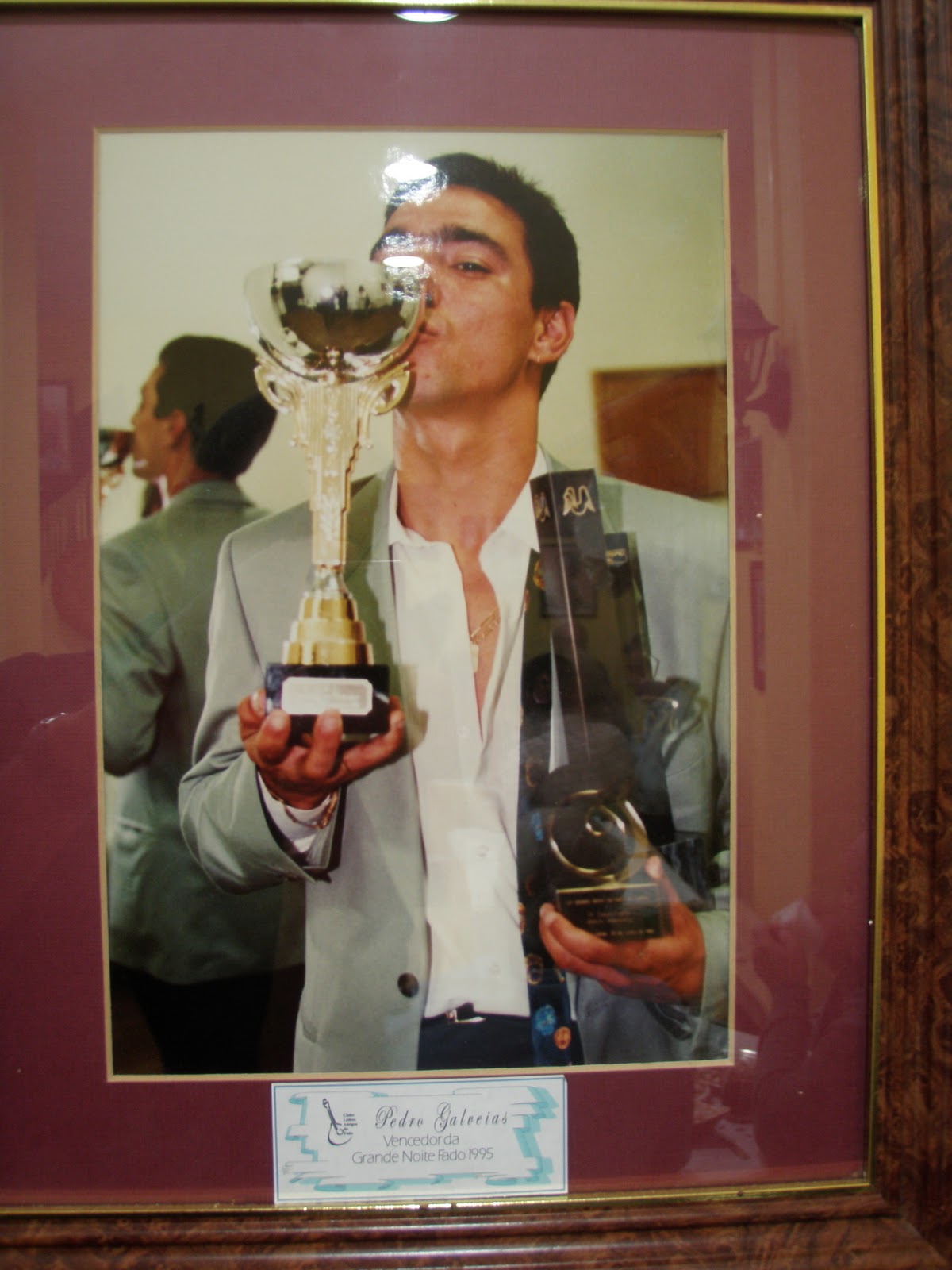
Pedro Galveis, 1995 Grande Noite de Fado
Pedro recently (12-Jan-2012) appeared on Portuguese TV singing Eu Quero, and also being interviewed. Pedro is worth seeking out if you ever visit Lisbon. He sings regularly at Os Ferreiras, and at various locations around the city (tough to predict exactly where). Though still only in his 40s, he has been singing for more than 30 years--and the experience shows. He won the Grande Noite do Fado twice, first in the young people's category (in 1986), then in the adult category (in 1995--see photo). He is one of a group of very successful singers of this generation, including Jaime Dias, Luis Matos, Vítor Miranda, Ricardo Ribeiro and Miguel Ramos. All of them were deeply influenced by the great Fernando Maurício, particularly in their ability to communicate directly with their audience.

I've had many opportunities to hear Pedro and to speak with him, both in Portugal and in the US. In Lisbon, he sang frequently in the Mouraria (here's a writeup, in English, of one such event, along with video, but here's another). In the US, he visited Newark, NJ not so long ago. Here's a sample.

The record is available on iTunes (even in the US!).


18 December 2011

Fado in 2011: Notable Fado CDs, Films, etc.

This was a banner year for the fado. In addition to sound recordings, there were films, publications and some noteworthy events--most importantly UNESCO's designation of the fado as "Immaterial World Patrimony". Below is a list with a few links and even fewer comments: I'll add more of both as soon as I can. Please give your own recommendations in the comments: I'd like to know what I missed!

Recordings
Below I've listed ten fado recordings from 2011. For the traditionalists, I would heartily recommend the records by Aldina Duarte and Pedro Galveias, as well as anything from the collection "Fados do Fado." The records by Fábia Rebordão and Luisa Rocha are definitely fado, though some of the tracks borrow instruments and musical stylings from other forms.

Five Notable Recordings
Fábia Rebordão. A Oitava Cor*


Aldina DuarteContos de Fados


Pedro Galveias: Loucuras de Um Fado*
Luisa Rocha: Uma Noite de Amor


Various. Fados do Fado
Five Other Recordings
Cuca Rosetta: Cuca Rosetta
Amália Rodrigues: Amália no Olympia (reissue)
Célia LeiriaCaminhos
Helena Sarmento Fado Azul
Vánia Duarte: Efeito do Fado

And in case you missed it...
Various: Biografia do Fado. This is one of the best introductions to the fado that I know of.

*available on iTunes in the US (I mention this because alot of the other records are going to be hard to find outside of Europe).


Films
All of these are documentaries, with interviews and performances. Most are being shown on RTP, though the transmission is not always available outside of Portugal.
Fernando Maurício
  • "O Rei Sem Coroa" is a long overdue film about Fernando Maurício (left), made by Diogo Varela Silva
  • "Vida vivida" is a film about Argentina Santos, made by Gonçalo Megre. 
  • "Não sei se canto se rezo" is a second film about Argentina Santos, director unknown (to me).
  • "Heaven's Mirror" is a film about the journey of a non-Portuguese--the film's director, Joshua Dylan Myers--to the fado. No distributor yet!
  • "Fado das Horas" is a short film that is pure visual poetry, also by Diogo Varela Silva. Watch it here.


Publications
I'll have to say more about this later, but the next time you're in Lisbon check out the bookstore at the Fado Museum. In the meantime, Ellen Gray's book on the fado should be out "soon"--watch for it!

UNESCO
The fado has been recognized by UNESCO as Immaterial World Patrimony. Good news? Bad news?

Departures
José Fontes Rocha
I know there were others, but I did not keep a list. Maybe next year.

15 December 2011

Fado at Carnegie Hall, New York City, on January 24, 2012

The fado is about to make one of its rare Carnegie Hall appearances. In fact, this is just the fourth time that this music is to appear in the illustrious space. (Update: See my report on the show.)

The event is "Fado: From Lisbon to New York". The title should be taken literally. The singers and musicians are not just some of the best in Lisbon, they are also part of a tight-knit group that has been playing together for years. The artists span multiple generations and include two of the most influential people on the fado scene today, the singer Celeste Rodrigues and the singer, composer and lyricist Jorge Fernando.

Celeste Rodrigues
Celeste Rodrigues' reputation within the Portuguese fado community stretches back to the 1940s. She returned from a year-long stay in Brazil in 1945 with a new, distinctive style that has marked her as much more than the sister of Amália Rodrigues. While her discography includes nearly 60 releases, they are exceedingly difficult to find (with the exception of a recent release, Fado Celeste). She continues to sing in some of the most illustrious fado houses in Lisbon, and is regarded as one of the last linkages to the time when fado was not nearly as well known as it is now. Indeed, at 88 she is the oldest practicing fado singer in Lisbon (for those who are wondering, Argentina Santos is one year younger).
José Manuel Neto

Jorge Fernando and Fábia Rebordão
Celeste is being joined by two other female singers, Fábia Rebordão and Filipa Cardoso. Fábia's voice and command of the material have grown in strength and stature. In the true spirit of the fado, she is able to take an established fado and sing it like no one else has. She is also a lyricist and composer. Both Fábia and Filipa draw on both the established repertory of the fado, broadened with lyrics composed by contemporary poets such as Mário Rainho (who has written extensively for Ana Moura and many others), Aldina Duarte, Manuel de Freitas, and Jorge Fernando.

Filipa Cardoso
The musicians for this concert are among the best that the country has to offer. José Manuel Neto, who plays the Portuguese guitar, is prolific--and busy. You can find him on YouTube, wearing flip-flops and playing in an obscure tavern in the south of Portugal, and the next day on stage with the biggest names in fado. Jorge Fernando has been involved in the fado since the the days when he was contracted by Fernando Maurício and Amália Rodrigues to write and play for them. Probably his best known composition in the USA is "Chuva", as sung by Mariza.

The concert represents a confluence of all these traces of the fado, stretching back over more than forty years, yet intimately strung together.

More information on the show, including ticket information, is here. The event is being organized by MD Fado Productions, led by Michael da Silva. Thanks to DVS for the added information and clarifications on on Celeste Rodrigues' career.

05 December 2011

Artur Batalha!

Many thanks to César Ferreira (from Os Ferreiras) for posting these two videos of Artur Batalha from 1975. I make it a habit not to take up posts with links to YouTube videos, but these are truly exceptional for their rarity and quality. Plus it's Batalha!


"Tempos da Criança"

Letra: Eduardo César
Música: Clemente Pereira @ 1975

Guitarra Portuguesa: António Chaínho / José Luís Nobre Costa 
Viola: José Maria Nóbrega
Viola-Baixo: Raúl Silva

"A Cruz Que Te Dei"

Letra: Alexandre Fontes
Música: Jorge Fontes @ 1975
Guitarra Portuguesa: António Chaínho / José Luís Nobre Costa 
Viola: José Maria Nóbrega
Viola-Baixo: Raúl Silva

And years later....
"A Cruz Que Te Dei"
Guitarra Portuguesa: Carlos Gonçalves
Viola: Lelo Nogueira


For the truly committed, I put together two YouTube playlists with all the videos of Batalha singing live that I know of. The first set is mostly my videos; the second is all from others.